Debunking the Myths about Fibroids
Dr Eisen Liang, MBBS, FRANZCR
Interventional Radiologist | Founder and Director, Sydney Fibroid Clinic
Widely circulated misinformation can delay or derail a woman’s path to proper care. Here we bust common fibroid myths using the latest medical research.
🚫 Myth #1: A Large or Fast-Growing Fibroid Menas Cancer
✅ Truth: Size or growth rate do not predict uterine cancer.
Only 2.6% of uterine malignant sarcomas had a history of rapid growth — most are slow-growing [1]. Don’t confuse a large or fast-growing fibroid with malignancy.
🚫 Myth #2: Fibroids Can Turn Into Cancer
✅ Truth: Fibroids are benign tumours and do not become cancer.
Fibroids affect up to 70% of women by age 50, but the chance of finding a cancerous tumour (uterine sarcoma) in a woman with fibroids is less than 0.3% [2].
🚫 Myth #3: You Can’t Tell If Your Fibroid Is Cancer or not Unless We Take It Out
✅ Truth: MRI with Diffusion Weighted Imaging (DWI) is highly accurate.
Modern MRI techniques can distinguish benign fibroids from uterine sarcomas without surgery. One recent study showed a 98% sensitivity and 96% specificity in identifying malignancy with MRI DWI [3].
References:
- Parker WH, Fu YS, Berek JS. Uterine sarcoma in patients operated on for presumed leiomyoma and rapidly growing leiomyoma. Obstet Gynecol. 1994;83(3):414–418.
- Stewart EA. Differentiating uterine leiomyomas (fibroids) from uterine sarcomas. UpToDate. 2025. Available from: https://www.uptodate.com/contents/uterine-fibroids-leiomyomas-differentiating-fibroids-from-uterine-sarcomas
- Abdel Wahab C, Jannot AS, Bonaffini PA, et al. Diagnostic algorithm to differentiate benign atypical leiomyomas from malignant uterine sarcomas with diffusion-weighted MRI. Radiology. 2020;297(2):361–371. doi: 10.1148/radiol.2020191658. PMID: 32930650.
The difference between fibroids and sarcoma (malignant fibroid)
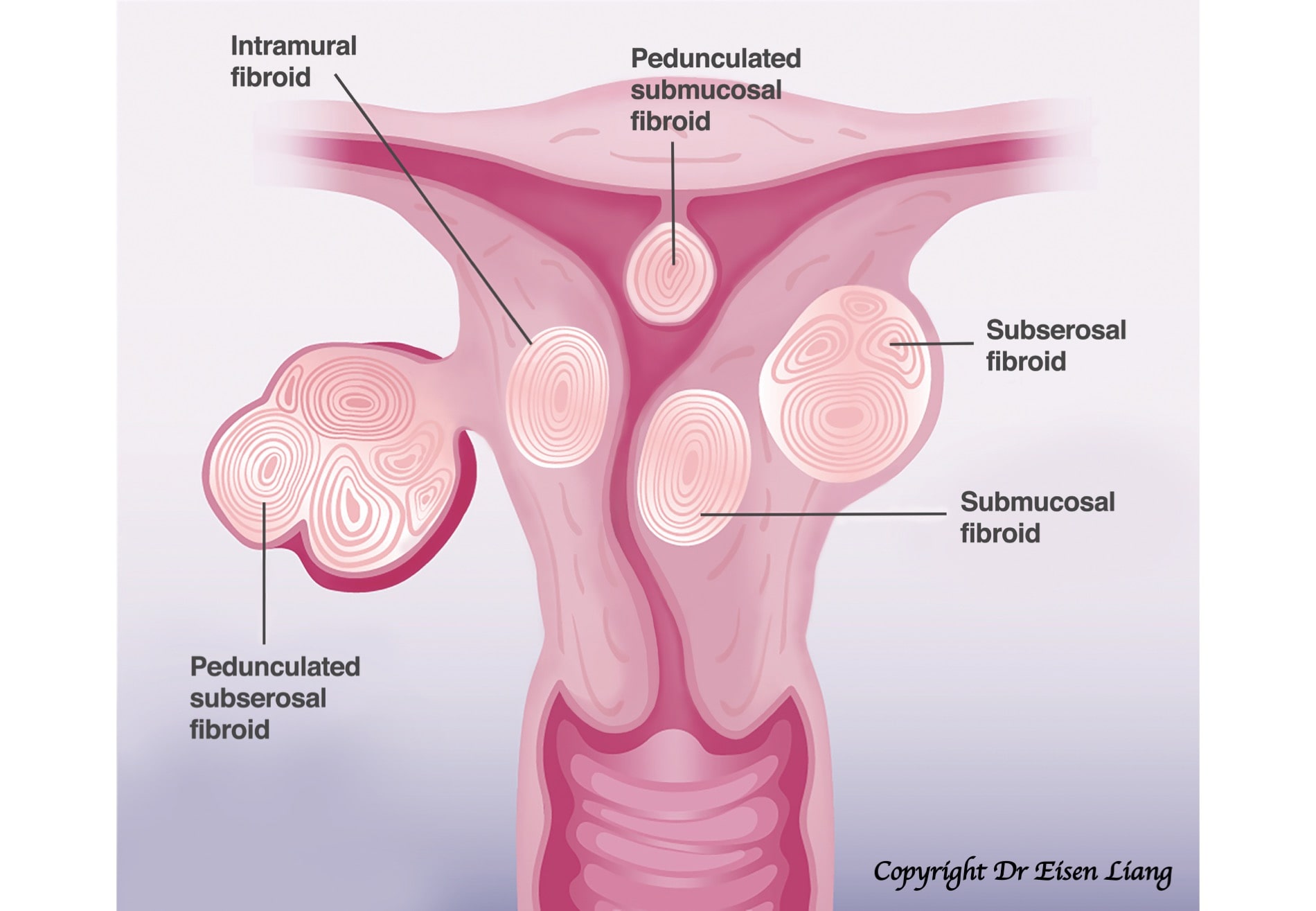
Fibroids, also called leiomyomas, are benign tumours arising from the muscle of the uterus. A typical fibroid does not usually “turn into” cancer. Uterine sarcomas are separate, uncommon malignant tumours that can sometimes resemble fibroids on imaging. It is therefore not that an ordinary fibroid can become cancerous, but that a rare sarcoma may initially be mistaken for a fibroid on imaging.
Fibroids are a very common, non-cancerous growth in the uterus, said to be present in upto 70% of wemon. Fibroids do not turn malignant.
Sarcoma is very rare and is only found in three per thousand cases of hysterectomies for fibroids. Rapid growth and large size of uterine tumours do not predict sarcoma. In fact, the sarcomas are mostly slow growing. Many benign uterine fibroids can grow quite quickly, it does not mean they’re nasty.
A fear of sarcoma should not normally be construed as a reason for a hysterectomy, as a hysterectomy itself is a major operation, with complications and death rates. The American College of Obstetricians and Gynaecologists does not recommend a hysterectomy solely to rule out sarcoma.
New or enlarging uterine masses after menopause deserve careful investigation, especially in women who are not on menopausal hormone therapy.
Ultrasound cannot reliably diagnose a sarcoma. Recent studies have shown that MRI with diffusion-weighted imaging (DWI) can help to distinguish fibroids from sarcoma with high accuracy.
Can MRI distinguish a fibroid from a uterine sarcoma?

No test can diagnose or exclude every uterine sarcoma with complete certainty. However, modern with diffusion-weighted imaging can identify features that make a uterine mass more likely to be benign or suspicious.
A 2020 French study developed a structured MRI algorithm for differentiating atypical fibroids from uterine sarcomas. The algorithm achieved high accuracy.
A subsequent international consensus statement published in Radiology provided guidance on using MRI to assess the risk of leiomyosarcoma. MRI can therefore provide valuable reassurance when appearances are convincingly benign and can identify women who require gynaecological-oncology assessment.
Explore Non-Surgical Fibroid Treatment with UFE
If you’re considering fibroid treatment options, don’t let myths limit your choices. UFE is a safe, uterus-preserving, and effective non-surgical treatment for fibroids — backed by 30 years of evidence.
🔗 Learn more about UFE and fibroid care here:
👉 www.sydneyfibroidclinic.com.au/fibroids/fibroid-treatment
References:
Abdel Wahab C, Jannot AS, Bonaffini PA, et al. Diagnostic algorithm to differentiate benign atypical leiomyomas from malignant uterine sarcomas with diffusion-weighted MRI. Radiology. 2020;297(2):361–371. doi: 10.1148/radiol.2020191658. PMID: 32930650.
Hindman N, Kang S, Fournier L, Lakhman Y, Nougaret S, Reinhold C, et al. MRI evaluation of uterine masses for risk of leiomyosarcoma: a consensus statement. Radiology. 2023;306(2):e211658. doi: 10.1148/radiol.211658. PMID: 36194109.
About the author: Dr Eisen Liang, MBBS, FRANZCR, is a specialist interventional radiologist and Founder and Director of Sydney Fibroid Clinic. He has extensive clinical experience in uterine artery embolisation and has published several peer-reviewed research on the diagnosis and minimally invasive treatment of fibroids and adenomyosis. He collaborates closely with gynaecologists to provide all appropriate treatment options to treat fibroids and adenomyosis.
Dr Eisen Liang presented an MRI-based approach to assessing atypical uterine masses to diagnostic radiologists at the ARGANZ 2024 meeting in Melbourne. His clinical practice includes reviewing pelvic MRI before uterine fibroid embolisation to assess fibroid characteristics, treatment suitability and any features requiring further assessment.
Dr Liang’s Publication list can be found: https://sydneyfibroidclinic.com.au/dr-eisen-liangs-research-and-publications/