Many Australian women are troubled by fibroids symptoms such as heavy menstrual bleeding, period pain, bladder and pressure symptoms.
Often, they have been told to put up with it, wait for menopause, or have a hysterectomy.
Have you ever wondered if we can shrink fibroid without cutting out the uterus?
Thankfully we are in the 21st Century, there is now a much less invasive alternative to a hysterectomy. It is called UFE or Uterine Fibroid Embolisation.
Local anaesthetic, no surgical incisions, one night in hospital, one-week recovery-too good to believe? Read on to find out more.
What is a uterine fibroid embolization (UFE)?
UFE (Uterine Fibroid Embolisation), also known as UAE (Uterine Artery Embolisation), is a minimally invasive radiological procedure that will shrink fibroids and alleviate fibroid symptoms such as heavy menstrual bleeding (HMB), period pain, pelvic pressure and bladder symptoms. Studies has shown that UFE is as effective as hysterectomy, but much less invasive with quicker recovery.
Haven’t heard about this? Well, your gynaecologist might not have mentioned UFE, which is performed by an Interventional Radiologist, not gynaecologists.
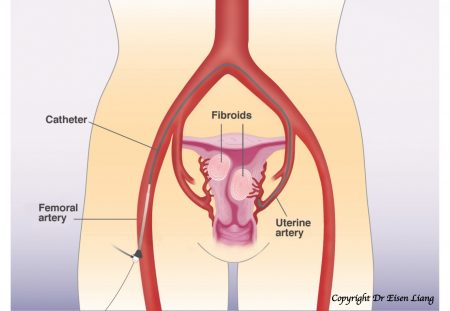
UFE Uterine Fibroid Embolisation-a non-surgical treatment.
How is UFE done?
UFE is performed under local anaesthetic and sedation. A small tube called catheter is inserted into the femoral artery in the groin. Using modern X-ray equipment, the catheter is then navigated to the arteries to the uterus. Small plastic particles (usually PVA polyvinyl alcohol) the size of sands are mixed with X-ray dye and injected to shut down the blood supply so that the fibroids will shrink and die. Patients stay overnight in hospital and may resume normal activities in one week.
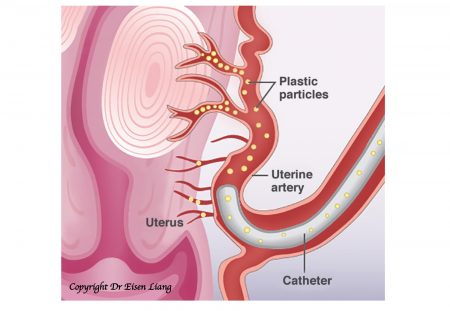
During UFE, small particles are injected to block the arteries to the uterus.
Watch this video: How does UFE work?
How does UFE shrink fibroids without harming the normal uterus?
The uterus is a very special organ in human body. It is only about 60 to 80 ml when a woman is not pregnant. During pregnancy, we know that the uterus enlarges tremendously, carrying with it 40 times increase in blood flow. The uterus has an immense capacity to re-open and recruit dormant blood vessels when needed, like during pregnancy. Once the baby is born, the uterus shrivels down and most of the blood vessels also shut down. Abnormal growths like fibroids do not have the ability to reopen or recruit blood vessels. Particles blocking the blood vessels supplying fibroid will lead to shrinkage. Some particles may enter normal myometrial tissue, causing transient lack of oxygen, but dormant vessels are then recruited to keep normal uterus alive. As a result, the fibroids die, and normal uterus remains alive.
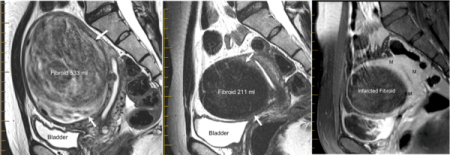
Case Study 1: 43 year old teacher with a bulging abdomen
She also suffers from bloating and pressure symptom, as well as frequency of urination day and night. She is well and healthy otherwise, and she is not keen in major surgery. Note the marked reduction of fibroid volume from 533ml to 211ml at 6 month progress MRI; the fibroid is dead, no longer viable, seen as dark signal without contrast enhancement; the normal looking viable enhancing myometrium is labelled “M”. All her bladder symptoms have resolved. She is glad that she can fit her jeans again.
Does size and number matter for UFE?
No. UFE treats all fibroids, large or small, one or multiple are by the same procedure-blocking of the left and right uterine arteries by flowing in small particles. Therefore, the number of fibroids does not matter.
Size does not matter in general. On average, fibroid will shrink 60% of its volume. This amount of shrinkage is sufficient for symptom control in more than 90% of patients.
Fibroid shrinkage is related to the composition of the fibroid. Active fibroids that are rich in cells and blood suppl tend to shrink more, than “fibrous” or less active fibroids.
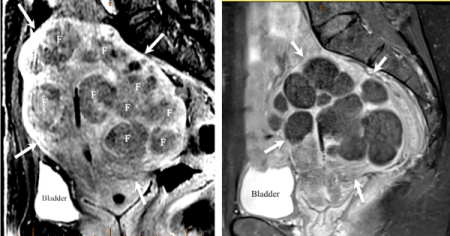
Case Study 2: 48 year old wife of a doctor failing conservative treatments
She suffers from severe heavy menstrual bleeding (HMB) and failed conservative treatments including removal of some of the fibroids and Mirena. She continued to suffer from HMB but declined hysterectomy. Pre-UFE MRI showed multiple fibroids denoted as “F”. After UFE, fibroids are shrunken, scarred and no longer viable, seen as dark nodules. The uterine volume reduced from 781ml to 349ml. Her periods become very light and she is very happy –”UFE changed my life”.
How effective is UFE?
UFE was first reported in 1995. Since then many research studies have document the effectiveness. There are now 7 randomised control trials (RCTs) comparing UFE with surgery (myomectomy or hysterectomy). The results were summarised by Cochrane review in 2014. Cochrane is the highest level of medical evidence when it comes to comparing treatment options. Cochrane stated that UFE has similar outcome compare with surgery, in terms of symptom relief, patient satisfaction and quality of life improvement. In other words, UFE is as effective as hysterectomy, but less invasive and with quicker recovery.
Watch Video: UFE on Channel 7 News
How soon do we see the effect of UFE?
For heavy periods, quite often the menstrual loss is noticeably reduced at the first menstrual period after UFE. Pressure and bladder symptoms might take 2-3 months to be noticeably relieved.
Is pregnancy possible after UFE?
Many research studies suggest pregnancy is possible after UFE. There seems to be no foetal growth retardation. However, when compared with a general obstetric population, the rate of miscarriage, pre-term delivery and post-partum haemorrhage is higher in women who have undergone UFE. This is probably related to the fibroid disease itself rather than the UFE procedure.
Summary
UFE is a minimally invasive angiographic procedure that has been proven to be safe and effective to treat fibroid related symptoms. It is performed under local anaesthetic, requires 1-night stay in hospital and 1-week recovery. It is most suitable for women who wish to avoid a hysterectomy.
Myomectomy compared with UFE
Myomectomy and uterine fibroid embolisation (UFE) both treat fibroids while preserving the uterus, but they work differently.
Myomectomy is a surgical operation that removes individual fibroids and may be performed hysteroscopically, laparoscopically, robotically or through an open abdominal incision.
UFE is a minimally invasive radiological procedure performed through a small arterial puncture. Tiny particles are delivered into the uterine arteries to reduce blood flow to the fibroids, causing them to die and shrink.
Myomectomy may be particularly suitable when there are one or several accessible fibroids that can be completely removed. Myomectomy might not be desirable when there are multiple fibroids. It can be difficult or impossible to remove all the fibroids. Any fibroids left behind will continue to grow and cause recurrence of symptoms.
UFE can be advantageous when there are multiple fibroids because it treats all fibroids throughout the uterus in one go, without requiring each one to be treated individually. UFE usually involves one night hospital stay and faster recovery, while recovery from myomectomy varies considerably depending on whether hysteroscopic, laparoscopic or open surgery is required.
Both treatments provide substantial improvement in bleeding, pressure and quality of life.
For women planning pregnancy, myomectomy is generally the preferred treatment when surgery is safe and possible, because pregnancy evidence after myomectomy is more established.
Successful pregnancies can occur after UFE, but its effects on fertility and pregnancy remain less certain.
Treatment therefore needs to be individualised according to fibroid size, number and location, symptoms, previous surgery, age, fertility plans, and whether the woman places greater priority on symptom relief or fertility; complete removal.
Other Fibroid Treament Options
Medical therapy for fibroids

Tranexamic acid, nonsteroidal anti-inflammatory drugs (NSAIDs), birth control pills, or progesterone agents may be used to treat heavy menstrual bleeding; however, these treatments do not reduce the size of uterine fibroids.
Tranexamic acid reduces heavy periods by enhancing the body’s clotting ability. Rare but serious side effects such as deep venous thrombosis (DVT) and pulmonary embolism (clots in the lung) may occur. Therefore, it is not recommended for women with an increased risk of arterial or venous thrombosis.
NSAIDs are mainly used for period pain but are not as effective as tranexamic acid for heavy periods.
Combined birth control pills are commonly prescribed for heavy menstrual periods. As fibroid growth is dependent on oestrogen, fibroid growth should be monitored. A progestogen-only pill can also be used to control heavy periods.
Gonadotropin-releasing hormone (GnRH) agonists can be used to induce temporary menopause, thereby reducing blood supply and shrinking fibroids. They are usually used for three to six months before fibroid surgery. Common side effects include hot flushes, mood changes and osteoporosis. Use is generally limited to six months, and fibroids usually regrow after GnRH agonists are stopped.
Ryeqo for fibroids
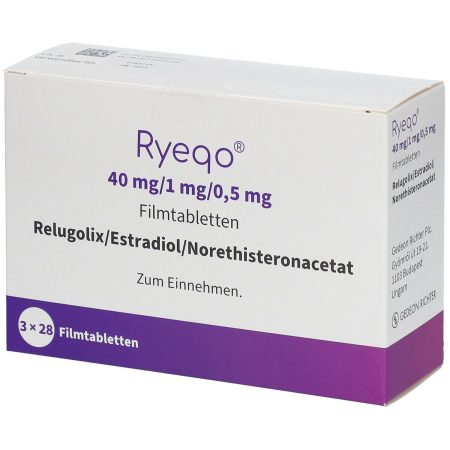
Ryeqo is a hormone based oral medication with 3 ingredients. It can be used to alleviate fibroid related heavy menstrual bleeding.
Ryeqo can also be used to supppress endometriosis.
The first ingredient is the GnRHa relugolix, which inhibits the release of pituitary stimulating hormones, thus reduces oestrogen and progesterone production from the ovaries. The second ingredient is an oestrogen to alleviate menopause-like symptoms and prevent osteoporosis. The third ingredient is a progestogen to protect the endometrium.
Ryeqo can be used to alleviate fibroid-related heavy menstrual bleeding. However, clinical trials showed only a modest fibroid-volume reduction of approximately 12% at six months. It is much less effective at shrinking fibroids than uterine fibroid embolisation (UFE), which shrinks fibroid volume by approximately 60% on average at six months.
In summary, Ryeqo is a combination hormone-based oral treatment that can alleviate heavy menstrual bleeding but is not particularly effective at shrinking fibroids.
References:
Liberty 1 and Liberty 2 Trials in N Engl J Med 2021
Ryeqo for endometriosis: What is Ryoq0 by RACCG
Mirena IUD for fibroids
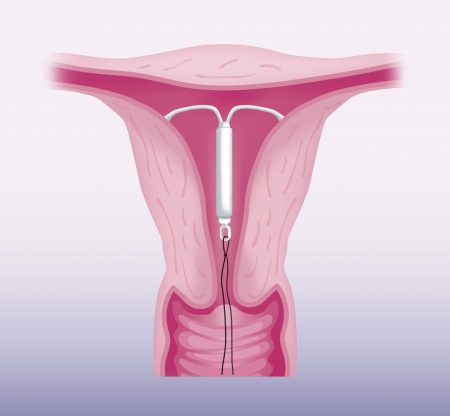
Mirena IUD
Mirena may reduce heavy bleeding but will not shrink fibroids.
Mirena is an intrauterine device (IUD). It is a T-shaped plastic device that slowly releases the hormone levonorgestrel, a progestogen, and can provide contraception for several years.
Although helpful for relieving heavy periods, Mirena does not reduce the size of fibroids or stop fibroid growth. If uterine fibroids are large and distort the uterine cavity, Mirena may be difficult to insert or remove, and the device may not remain in place.
In some women, heavy bleeding is replaced by prolonged spotting, which can be troublesome. Known side effects include prolonged light bleeding and irregular bleeding. Less common side effects include weight gain, ovarian cysts, lower abdominal pain and acne.
Mirena can be inserted in the consulting rooms of a GP or gynaecologist. In some cases, insertion may need to be performed in an operating theatre under sedation or a light general anaesthetic, depending on the anticipated difficulty.
Endometrial ablation for fibroids
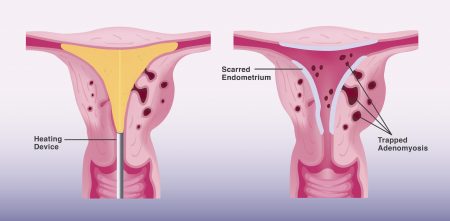
Endometrial Ablation causes more pain in adenomyosis
Endometrial ablation does not shrink fibroids themselves.
Ablation uses heat or another form of energy to destroy the inner lining of the uterus. It is generally performed under anaesthesia. If successful, menstrual bleeding will be reduced, but ablation does not shrink fibroids and will not relieve symptoms caused by the bulk or size of uterine fibroids.
If the uterine cavity is distorted by fibroids, ablation may be ineffective because the treatment device cannot make adequate contact with the entire uterine lining.
If adenomyosis is also present, endometrial ablation may fail to relieve symptoms and can sometimes lead to persistent or worsening period pain.
Magnetic Resonance-Guided Focused Ultrasound (MRgFUS) for Fibroids
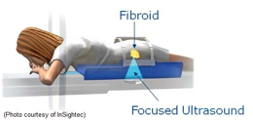
MRgFU for Fibroids
MRgFUS stands for Magnetic Resonance-guided Focused Ultrasound. MRgFUS produces heat energy to cause cell death in fibroids. This minimally-invasive technique uses a MRI thermal imaging system to continuously measure temperature changes inside the body, guiding the treatment.
MRgFUS treatment needs to be planned very carefully to avoid skin burns, bone or nerve damage, or thermal injury to bowels. Fibroids too close to the skin, spine or bowels are not suitable. Multiple fibroids and large fibroids are usually not suitable due to long procedure time.
The procedure can take 3-4 hours depending on the size(s), with patient lying face down inside the MRI machine. It is NOT currently funded by Medicare or health fund. Sydney Fibroid Clinic does NOT provide this treatment. The treatment is available in Melbourne.
About the author:
Dr Eisen Liang is an Interventional Radiologist who founded Sydney Fibroid Clinic. He has worked collaboratively with gynaecologists for more than 15 years in helping women to resolve fibroid related symptoms. His research papers on fibroid disease have been presented internationally and published in ANZJOG. View his reseaerch publications: https://sydneyfibroidclinic.com.au/dr-eisen-liangs-research-and-publications/
For further information, please visit www.sydneyfibroidclinic.com.au