Pelvic Congestion Syndrome

Pelvic congestion syndrome – or PCS – causes chronic pelvic pain in women. This pain usually feels like a deep, dull pelvic ache. It may be worse after upright positions – like sitting, standing, walking and running – or after activities involving the Valsalva Maneuver – like weightlifting and singing.

Pelvic Congestion Syndrome
Pelvic congestion syndrome – or PCS – causes chronic pelvic pain in women. This pain usually feels like a deep, dull pelvic ache. It may be worse after upright positions – like sitting, standing, walking and running – or after activities involving the Valsalva Maneuver – like weightlifting and singing.

What Is Pelvic Congestion Syndrome?

Pelvic congestion syndrome is a chronic pain syndrome in women caused by reflux of the ovarian vein, resulting in congested and dilated veins in the pelvis. Typically the pain is worse after being in upright positions like standing and sitting, or after exercise like walking, running and weightlifting.

Pelvic Congestion Syndrome: Diagnosis

The symptoms of pelvic congestion syndrome are:

  • Deep, dull aching pelvic pain
  • Pain worse after upright positions, like standing and sitting
  • Pain worse after exercise, like walking, running and weightlifting
  • Pain during or after intercourse
  • Back and thigh pain
  • Varicose veins around the genitals and in the legs

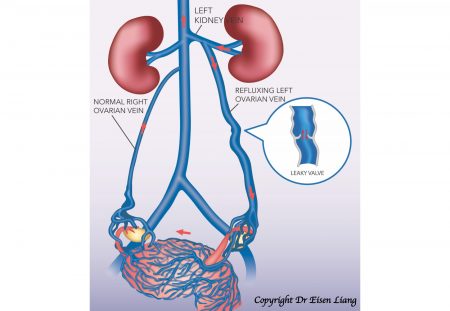
The underlying cause is due to reflux (going the reverse direction) of the ovarian vein which pressurises and overwhelms the pelvic veins leading to enlargement of the pelvic veins, congestion and therefore pain.

Many women with pelvic congestion syndrome only find pelvic pain relief when lying down.

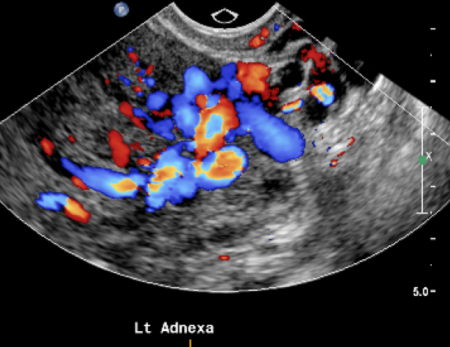
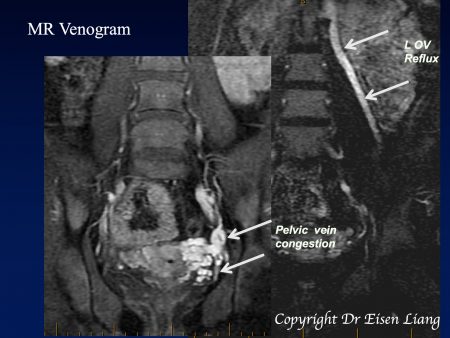
Diagnosis can be made by combining typical symptoms with medical imaging. Pelvic ultrasound quite often detects dilated and congested pelvic varicose veins. MRI can also demonstrate reflux in the  ovarian vein, in addition to congested pelvic veins . However, MRI for this condition is not covered by Medicare. CT scans can clearly demonstrate pelvic varicose veins as well as the refluxing ovarian vein.  CT scan is most useful for planning the embolisation (blocking) treatment, but involves some radiation and a contrast (X-ray dye) injection.

Dilated pelvic veins can sometimes incidentally discovered at laparoscopy looking for something else. However, laparoscopy is not the appropriate test if one is looking for pelvic congestion syndrome. Pelvic veins are usually collapsed during laparoscopy, due to the head down body tilt and gas used to distend the abdomen.

Pelvic congestion syndrome seems to be an under-recognised and under-diagnosed cause of pelvic pain in women. As chronic pelvic pain can be caused by a variety of conditions, diagnosis of pelvic congestion syndrome is often delayed as doctors are more inclined to organise tests to rule out more sinister conditions like infection, inflammation and cancer in the bowel and other pelvic organs.

Pelvic Congestion Syndrome: Diagnosis
The symptoms of pelvic congestion syndrome are:
Deep, dull aching pelvic pain
Pain worse after upright positions, like standing and sitting
Pain worse after exercise, like walking, running and weightlifting
Pain during or after intercourse
Back and thigh pain
Varicose veins around the genitals and in the legs
The underlying cause is due to reflux (going the reverse direction) of the ovarian vein which pressurises and overwhelms the pelvic veins leading to enlargement of the pelvic veins, congestion and therefore pain.
Many women with pelvic congestion syndrome only find pelvic pain relief when lying down.
Diagnosis can be made by combining typical symptoms with medical imaging. Pelvic ultrasound quite often detects dilated and congested pelvic varicose veins. MRI can also demonstrate reflux in the  ovarian vein, in addition to congested pelvic veins . However, MRI for this condition is not covered by Medicare. CT scans can clearly demonstrate pelvic varicose veins as well as the refluxing ovarian vein.  CT scan is most useful for planning the embolisation (blocking) treatment, but involves some radiation and a contrast (X-ray dye) injection.
Dilated pelvic veins can sometimes incidentally discovered at laparoscopy looking for something else. However, laparoscopy is not the appropriate test if one is looking for pelvic congestion syndrome. Pelvic veins are usually collapsed during laparoscopy, due to the head down body tilt and gas used to distend the abdomen.
Pelvic congestion syndrome seems to be an under-recognised and under-diagnosed cause of pelvic pain in women. As chronic pelvic pain can be caused by a variety of conditions, diagnosis of pelvic congestion syndrome is often delayed as doctors are more inclined to organise tests to rule out more sinister conditions like infection, inflammation and cancer in the bowel and other pelvic organs.

Pelvic Congestion Syndrome Treatment

If you’re experiencing pelvic pain and require treatment, you may have pelvic congestion syndrome. Sydney Fibroid Clinic offers ovarian vein embolisation to treat symptoms of pelvic congestion syndrome.

  • Ovarian Vein Embolisation for Pelvic Congestion

    Venous Embolisation  is the treatment of choice for Pelvic Congestion Syndrome.

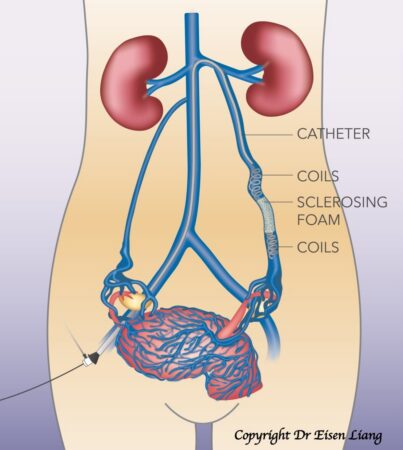
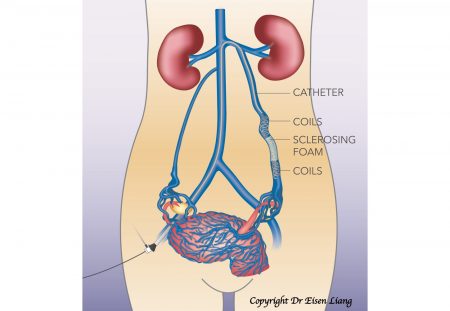
    The treatment targets the root cause of pelvic venous congestion: refluxing veins. The embolisation procedure blocks the refluxing veins to stop unnecessary venous backflow into the pelvis, thereby relieving the symptoms caused by congestion. A refluxing vein is a useless vein, overwhelming the existing drainage pathways, and therefore can be blocked. Just like how leg varicose veins can be treated by stripping, lasering or injection-to get rid of these useless veins. Inside the body, we will need to be more gentle, not to harm the adjacent organs like the bowel. Embolisation (blocking) is achieved with soft platinum coils- a very gentle way to treat PCS.

    The procedure and its benefits can be summarised as follows:

    • Local anaesthetic procedure
    • Minimally invasive, safe and effective
    • 89% immediate relief and 84% long-term relief (patient satisfaction rates)
    • No surgical cuts, no general anaesthetic
    • No down time, back to normal activities next day


    The local anaesthetic procedure is performed by an interventional radiologist in an angiography suite, as a day procedure. A light sedation is given, and the skin entry site is numbed with local anaesthetic. Note: nowadays, jugular vein is used for entry into the venous system, and this allows safe access to check and treat all 4 sets of potentially refluxing veins: the left and right ovarian veins, the left and right internal iliac veins.

    During the process, a tiny nick is made in the skin for a catheter (a small plastic tube) to be inserted. The catheter is navigated inside the vein under X-ray guidance. A diagnostic venogram is performed by injecting X-ray dye to show the veins and direction of blood flow. Once reflux is confirmed, platinum coils are fed through the catheter to block the vein. A sclerosing agent is injected to secure long-term blockage of the refluxing veins.

    The procedure takes about an hour, but it can be longer if additional refluxing veins are found and need to be treated.

    Post-procedure, patients require bed rest for 1 – 2 hours until the sedation wears off and will need to arrange transport, as driving is not allowed for 24 hours after sedation. Patients should take it easy at home, drink plenty of fluid and can resume normal activities the following day – though strenuous exercise should be avoided initially. The dressing should be kept in place for two days and then removed. Some patients may experience back and pelvic pain for 1 – 2 days after embolisation, though this can be controlled with Panadol and Nurofen.

    For more information on OVE as a pelvic congestion syndrome treatment, make an enquiry with Sydney Fibroid Clinic.

    Enquire About OVE

  • Laparoscopic Ligation for Pelvic Congestion

    Laparoscopic ligation is a surgical procedure in which a woman’s ovarian veins are tied off. Though tying off the ovarian vein is effective in 80% of patients with pelvic congestion syndrome, it is a much more difficult and invasive procedure than ovarian vein embolisation.  The refluxing internal iliac veins cannot be identified or treated by this method.  During venous embolisation procedure, all potential refluxing pathways can be tested and blocked if found. Therefore this surgical procedure is not as effective as Venous  Embolisation (OVE) and therefore it is rarely performed

  • Hysterectomy for Pelvic Congestion

    It is important to note that pelvic congestion syndrome is a venous problem and not a problem of the uterus. Therefore, it does not make sense to remove the uterus.

    A hysterectomy for pelvic congestion syndrome is ineffective in a large percentage of patients. Immediately following hysterectomy, pain is still present in 33% of patients. Recurrence of pelvic pain is noted in 20% of patients. A hysterectomy therefore should not be a treatment for pelvic congestion syndrome.

    The cause of pelvic congestion syndrome is the refluxing ovarian vein, which can be effectively blocked non-surgically by ovarian vein embolisation.

Do I Need Treatment?

If pelvic congestion syndrome symptoms are impacting your quality of life, you may need to seek treatment.


If you’re longing for effective pelvic pain treatment and simple measures have not been effective, OVE could be a minimally invasive treatment for you.

If you would like a specialist opinion, get a referral from your GP and book a consultation with Dr Liang.

Do I Need Treatment?
If pelvic congestion syndrome symptoms are impacting your quality of life, you may need to seek treatment.
 
If you’re longing for effective pelvic pain treatment and simple measures have not been effective, OVE could be a minimally invasive treatment for you.
If you would like a specialist opinion, get a referral from your GP and book a consultation with Dr Liang.

FAQs about Pelvic Congestion Syndrome (PCS)

To offer greater insight into pelvic congestion syndrome, pelvic congestion syndrome treatment and ovarian vein embolisation, Sydney Fibroid Clinic has compiled our frequently asked questions.

  • What causes pelvic congestion syndrome?

    Pelvic congestion syndrome is a chronic pain syndrome caused by distention and congestion of pelvic veins. The root cause is usually reflux in the ovarian vein, allowing backflow of venous blood into the pelvis.

    Reflux in the ovarian vein, allowing backflow of venous blood into the pelvis.

    Normal venous valves ensure blood returns towards the heart in one direction, but defective or absent valves cause reflux – blood flow in the reverse direction. Reflux in the ovarian vein creates congestion and raised venous pressure in the pelvic drainage area. It’s the pooling of stagnant blood and stretching of pelvic veins that produces pain in pelvic congestion syndrome.

  • How is pelvic congestion syndrome diagnosed?

    The key to the correct diagnosis is the women’s pain history.

    The symptoms of pelvic congestion syndrome are:

    • Deep, dull aching pelvic pain
    • Pain worse after upright positions, like standing and sitting
    • Pain worse after exercise, like walking, running and weightlifting
    • Pain during or after intercourse
    • Back and thigh pain
    • Varicose veins around the genitals and in the legs
    • Pain relief when lying down

    Diagnosis can be made by combining typical symptoms with medical imaging. Pelvic ultrasound quite often detects dilated and congested pelvic varicose veins.

    Pelvic ultrasound detects dilated and congested pelvic varicose veins.

    An MRI can not only show congested pelvic veins but also the refluxing ovarian vein – however MRI for this condition is not covered by Medicare.

    An MRI can show congested pelvic veins and the refluxing ovarian vein.

    CT scans can clearly demonstrate pelvic varicose veins as well as the refluxing ovarian vein. The CT scan is most useful for planning the embolisation (blocking) treatment, but involves some radiation and a contrast (X-ray dye) injection.

    A dilated pelvic vein can sometimes be discovered incidentally at a laparoscopy when looking for something else. However, laparoscopy is not the appropriate test if one is looking for pelvic congestion syndrome. Pelvic veins are usually collapsed during laparoscopy, due to the head down body tilt and compression by gas used to distend the abdomen.

    Pelvic congestion syndrome seems to be an under-recognised and under-diagnosed cause of pelvic pain in women. As chronic pelvic pain can be caused by a variety of conditions, diagnosis of pelvic congestion syndrome is often delayed, as doctors are more inclined to organse tests to rule out more sinister conditions like infection, inflammation and cancer in the bowel and other pelvic organs.


  • How is OVE performed?

    Ovarian vein embolisation (OVE) is a local anaesthetic procedure performed by an interventional radiologist in an angiography suite, as a day procedure. A light sedation is given, and the skin entry site is numbed with local anaesthetic. Either the jugular or femoral vein is used for entry into the vein.

    During the process, a tiny nick is made in the skin for a catheter (a small plastic tube) to be inserted. The catheter is navigated inside the vein under X-ray guidance. A venogram is performed by injecting X-ray dye to show the veins and direction of blood flow. Once reflux is confirmed, stainless steel or platinum coils are fed through the catheter to block the vein. A sclerosing agent is injected to secure long-term blockage of the refluxing veins.

    The procedure takes about an hour, but it can be longer if additional refluxing veins are found and need to be treated.

    Coils are fed through the catheter and sclerosing agent is injected to block the refluxing veins.

  • How effective is ovarian vein embolisation (OVE)?

    OVE is a procedure that blocks the refluxing ovarian vein, targeting the root cause of pelvic congestion syndrome. It is minimally invasive and can be performed as a day procedure under local anaesthetic. Clinical improvement and resolution of symptoms is reported in 83% of patients.

  • What are the advantages of OVE?

    Ovarian vein embolisation (OVE) is as effective as laparoscopic ligation, but is much less invasive and less risky. It does not require incisions in the abdomen, therefore allowing for faster recovery and less pain. No general anaesthetic is required and normal activity can be resumed the next day.

  • Is OVE painful?

    A small amount of local anaesthetic is injected at the skin to allow the insertion of the catheter into the vein. Ovarian vein embolisation itself is not a painful procedure. In some patients, injection of the sclerosing agent (Fibroivein) can cause pain in the back or the pelvis, that can last for 1 – 2 days after embolisation. This pain can be controlled with Panadol and Nurofen.

  • What are the risks of OVE?

    Although uncommon, minor complications such as bruising at the entry site may occur. Vessel injuries and drug allergies are rare, and coil loss in the lungs is extremely rare.

  • Am I a candidate for OVE?

    If you’re troubled by the symptoms of pelvic congestion syndrome, ovarian vein embolisation (OVE) could be an ideal pelvic congestion syndrome treatment. For more information on whether you’re a suitable candidate for OVE, ask your GP for a referral and book a consultation with Dr Eisen Liang.

    Enquire About OVE Treatment

  • How do I recover after OVE?

    After OVE, patients require bed rest for 1 – 2 hours until the sedation wears off and will need to arrange transport, as driving is not allowed for 24 hours after sedation. Patients should take it easy at home, drink plenty of fluid and can resume normal activities the following day – though strenuous exercise should be avoided initially. The dressing should be kept for two days and removed afterwards. Some patients may experience back and pelvic pain for 1 – 2 days after embolisation, though this can be controlled with Panadol and Nurofen. Follow-up with Dr Liang is scheduled one month after the procedure.

  • Do I need to see a gynaecologist about OVE?

    Sydney Fibroid Clinic believes in a multidisciplinary approach to diagnose and treat pelvic pain. It is important that other potential causes of pelvic pain have been ruled out by your GP and gynaecologist.

    By now, you should already have had a pelvic examination, Pap smear, pelvic ultrasound and perhaps other appropriate tests by your GP or gynaecologist. Your GP and gynaecologist will also take part in your follow-up, as well as your ongoing care.

UFE vs hysterectomy

Contact Sydney Fibroid Clinic

If you’re troubled by symptoms of pelvic congestion syndrome and simple measures have not been effective, OVE could be a viable pelvic congestion syndrome treatment for you; especially if you wish to preserve your uterus, avoid major surgery and recover quickly.

If you’re unsure and would like a specialist opinion, ask your GP for a referral and book a consultation with Dr Liang.

Contact Sydney Fibroid Clinic
If you’re troubled by symptoms of pelvic congestion syndrome and simple measures have not been effective, OVE could be a viable pelvic congestion syndrome treatment for you; especially if you wish to preserve your uterus, avoid major surgery and recover quickly.
If you’re unsure and would like a specialist opinion, ask your GP for a referral and book a consultation with Dr Liang.

Pelvic Congestion Syndrome Stories

Sydney Fibroid Clinic has aided a number of women in achieving severe period pain relief and pelvic pain relief associated with symptoms of pelvic congestion syndrome.

Read their stories below.

It took 30 years to diagnose my Pelvic Congeston Syndrome (PCS) in Sydney

It took 30 years to diagnose my Pelvic Congeston Syndrome (PCS) in Sydney

- CR

A Woman’s  Story: Living With Pelvic Congestion Syndrome

For almost 30 years, I lived with chronic pelvic pain without clear answers. Over that time, I saw many doctors and specialists and underwent repeated investigations, yet no one was able to explain why I was in pain.

I was referred by my GP to a gastroenterologist, an endocrinologist, and multiple gynaecologists. I was also sent to a vascular surgeon for leg pain and treated several times for varicose veins. Despite all these, no one connected my pelvic pain, leg symptoms, and daily worsening discomfort to Pelvic Congestion Syndrome (PCS). Most of the time, I was told to manage the pain with medication.

I have had multiple pregnancies. The pain I was suffering was a heavy, dragging sensation in my lower abdomen and back that worsened as the day went on, especially with prolonged standing. At times, the pain was severe, associated with nausea and vomiting, and radiated to my legs and vaginal area. Symptoms often worsened after intercourse. A Mirena did not give me long term relief.

The ongoing uncertainty and lack of diagnosis were deeply frustrating. The pain affected my work, family life, and important social moments. Over time, I began to believe that this was simply something I had to live with.

Everything changed when I decided to change my GP. My new GP took the time to listen and referred me to a gynaecologist in the Hills area who carefully considered my long history and pelvic venous congestion (PCS) was finally raised. I was then referred to a Sydney interventional radiologist for further assessment treatment.

I underwent ovarian vein embolisation (OVE) which was performed local anaesthetic and sedation by the Sydney Interventional Radiologist. In the days and weeks that followed, my pelvic pain settled significantly. I gradually stopped needing regular pain medication, the heaviness in my abdomen resolved, and the leg pain did not return. I no longer have to experience the severe, debilitating pain that once dominated my daily life.

Looking back, I wish pelvic congestion syndrome (PCS) had been considered much earlier. If you have long-standing pelvic pain that relates to upright posture and activities, keep asking can this be PCS — being heard can make all the difference.

This story describes an individual patient’s experience. Outcomes vary between individuals and this information does not replace personalised medical advice.

Thank You for Everything

Thank You for Everything

- E.T.

Ovarian vein embolization was a day procedure with little pain.

I was always in a lot of pelvic pain before my period and after days of being on my feet, which is every day. I also experienced pain after sex and it bothered me that I couldn’t understand where the pain was coming from. There were many times when I couldn’t ignore this pain and it would stop me from doing my work at home and in my workplace. I could only get relief if I was to lie down, but that was very unrealistic – especially while at work.

So, just like before, I tried to get answers but as no one could figure out the pain, I lived with it. After consulting with specialists at Sydney Fibroid Clinic, I was diagnosed with pelvic congestion syndrome. I had the ovarian vein embolisation procedure for PCS in early October 2017. This was a day procedure with little pain.

The result was wonderful. Since then I feel like my quality of life has improved immensely. I no longer suffer from pain while doing my normal daily activities and there’s no more pain after sex. I feel like I’ve gained a new lease on my life and I feel liberated. I truly hope that women who suffer from the same conditions as I have can find their way to Sydney Fibroid Clinic and experience such freedom with little down time and not have to resort to invasive surgery such as a hysterectomy.

Once again I’d like to say THANK YOU for everything that you have done to help me and give me a freedom from a condition that is unrecognised by many professionals and so simple to treat.

I Feel Like a New Woman -F.S.

I Feel Like a New Woman -F.S.

-

After the procedure I’m enjoying this new me…

Where do I start. For 11 years, I have seen many GPs, gynaecologists, chiropractors, physiotherapist, naturopath, kinesiologist, pain management specialist, the list goes on, but nobody could tell me why I was in agony and disabled every single day.  It hurts down my legs, in between my legs, my vagina, my bottom and my back. It feels like the pressure pushing down as if my insides were going to fall out. I struggled to stand.

After my third pregnancy I spent thousands and thousands of dollars searching for answers. I would stay up every night Googling my symptoms and was on chat groups with other women.

I struggled for years and had multiple MRI and CT scans, yet nobody could tell me why I was in constant agony.

I had 6 steriod injections in my back and I had no improvement whatsoever.

I was put on Lyrica, Mobic, Celebrax, I lived on Voltaren. I practically was living off pain medication and steroids for years and they weren’t doing anything to help me with the pain but I was gaining weight on steroid.

At one point I gave up searching for answers and became a miserable negative person. I saw a young women doctor hoping maybe she would understand but instead she prescribed me antidepressants because I was crying. I know I’m not a depressed person.

I went online Googling and found a gynaecolgist working together with an interventional radiologist. They heard me and listened to everything I had to say , and thoroughly went through my scans. This is something no other specialist has done before. Every other specialist I went to was just looking at the report instead of actually looking at my scans.

I was diagnosed of Pelvic Congestion Syndrome and was treated with Ovarian Vein Embolization which was a local anaesthetic day procedure with no down time.

After the procedure I was feeling amazing. I feel like I am a new woman. I am exercising again. I am sleeping again; I am a happier person. My life has changed in the most positive way because I am able to do the things that I couldn’t do for so many years.  I’m enjoying this new me.

Every day when I wake up and I’m ready to go for that jog and run I am so grateful that they gave me my life back.

For more information on pelvic congestion syndrome, get in touch.

For more information on pelvic congestion syndrome, get in touch.